
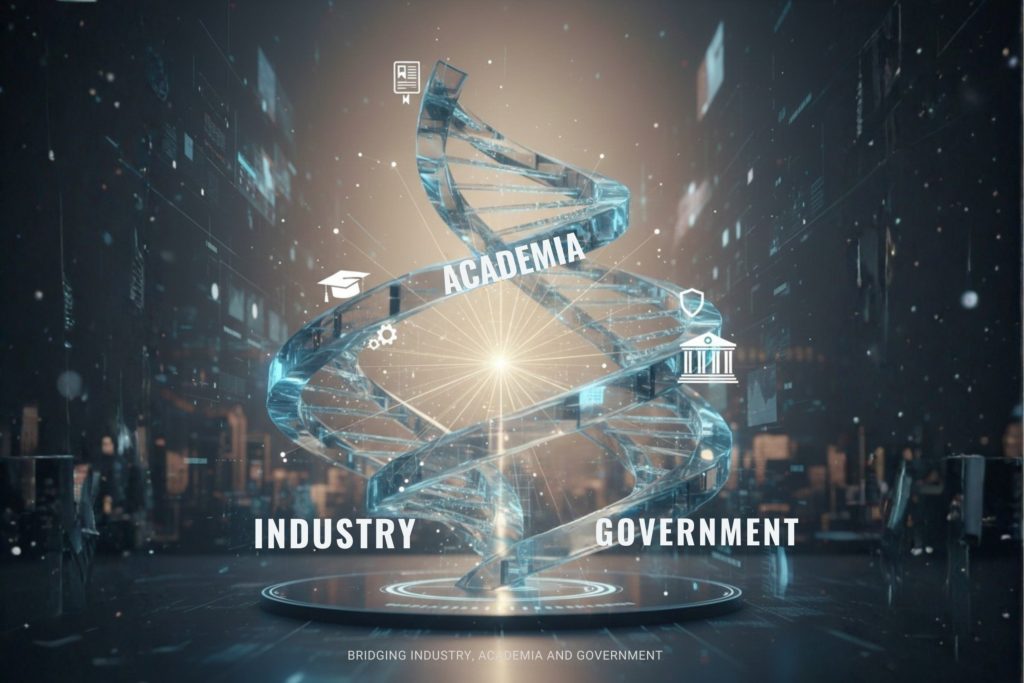
Sustainable development and national self-reliance (AtmaNirbhar Bharat) are no longer the responsibility of a single sector. The most successful innovation ecosystems globally—from Silicon Valley to the Cambridge Cluster—operate on the Triple Helix Model.
This model represents the dynamic interaction between:
- Academia (knowledge creators)
- Industry (wealth creators)
- Government (policy enablers)
1. The Collaborative Framework
Each pillar of the Triple Helix plays a unique but overlapping role in the innovation lifecycle:
| Pillar | Primary Role | Value in the Ecosystem |
|---|---|---|
| Academia | Knowledge Generation | Provides foundational research, advanced laboratories, and a pool of skilled talent (students/researchers). |
| Industry | Commercialization | Turns research into marketable products, provides private capital (CSR/VC), and defines real-world problem statements. |
| Government | Policy & Infrastructure | Creates an enabling environment through de-licensing, funding schemes (FAME-II, PM E-DRIVE), and national missions. |
2. DRIIV’s Role as the Orchestrator
DRIIV (Delhi Research Implementation and Innovation) acts as the “Ecosystem” that binds these three helices together.
As an initiative of the Office of the Principal Scientific Adviser (PSA) to the Government of India, DRIIV translates high-level policy into on-ground impact.
How DRIIV Facilitates Collaboration
For Government / Public Sector (The Public Partner)
- Solves complex public-sector challenges such as:
- Air quality monitoring with DPCC, GMDA
- Industrial waste management with MOEFCC / OIL
- Sources validated and deployable technology solutions.
For Industry (The Implementation Partner)
- Enables corporates and PSUs to co-create with innovators.
- Channels CSR capital into sustainable pilots.
- Ensures ESG goals are met with scientific rigor.
For Academia (The Research Partner)
- Provides a platform for researchers from:
- IIT Delhi
- IIIT Delhi
- AIIMS
- CSIR labs
- Helps scale innovations from “lab-scale” to “pilot-to-plant” stages.
3. Impactful Success Stories
The power of this collaboration is evident in DRIIV’s flagship projects:
Project Airview+
A unique Public-Private Partnership (PPP) involving:
- Google (Funding)
- Aurassure (Innovator)
- IIT Delhi (Technical Expert)
- GMDA / HSPCB (Government & Policy)
Objective: Tackling air pollution through validated, scalable monitoring solutions.
Collective Responsibility Drive (CRD)
- Collaboration with Blue Planet (Industry) and local government schools
- Recycled 1 billion plastic items into school desks
- Enabled community-led circularity and environmental awareness.
Sustainable Oil Sludge Treatment
- Piloted at Numaligarh Refinery Limited (NRL), Assam
- Treated 100 kg of oil sludge using a proprietary phycoremediation consortia of micro-algae
- Resulted in a jointly filed patent
- Offers a scalable, nature-based waste management solution for Indian refineries
- Sets a new benchmark for industrial circularity and environmental compliance
EV Infrastructure & Green Mobility
- Developed indigenous EV chargers and a Smart Charging Management System (CMS) for:
- Station discovery
- Slot booking
- Solarization of DTC bus depots with BSES Rajdhani
- Reduced operational costs and grid dependency
- Initiatives include:
- Battery swapping at Ranibagh
- Inter-city green mobility corridors
These projects provide a replicable national model for sustainable and accessible urban mobility.
Building a Resilient Innovation Corridor
DRIIV is building a resilient innovation corridor where technology is not just invented—it is implemented to solve pressing environmental and social challenges.
Frequently Asked Questions (FAQs)
What is the Triple Helix Model?
It is a framework where academia, industry, and government collaborate to drive innovation and economic growth.
How can a startup access DRIIV’s collaborative network?
Startups can upload their technology on the DRIIV portal to get validated and matched with relevant industry pilots or government use-cases.
Does DRIIV help in funding academic research?
Yes. DRIIV facilitates funding by mobilizing private CSR capital and connecting researchers to government grants and Innovation Challenges.
Why is government involvement crucial in S&T clusters?
The government provides:
- Regulatory frameworks
- Large-scale testbeds (e.g., public transport fleets)
- Alignment with national missions
What is “Co-creation” in the DRIIV ecosystem?
It is a process where industry players and researchers collaborate from day one to design solutions that meet both market and social needs.