
In the global race for technological leadership, innovation no longer happens in isolation. The most significant breakthroughs of the 21st century emerge from Science and Technology (S&T) Clusters—dynamic ecosystems where elite universities, deep-tech startups, R&D labs, and industry giants converge under a unified policy framework.
As India accelerates toward Viksit Bharat 2047, these global benchmarks provide a roadmap for our own growth.
What Defines a World-Class S&T Cluster?
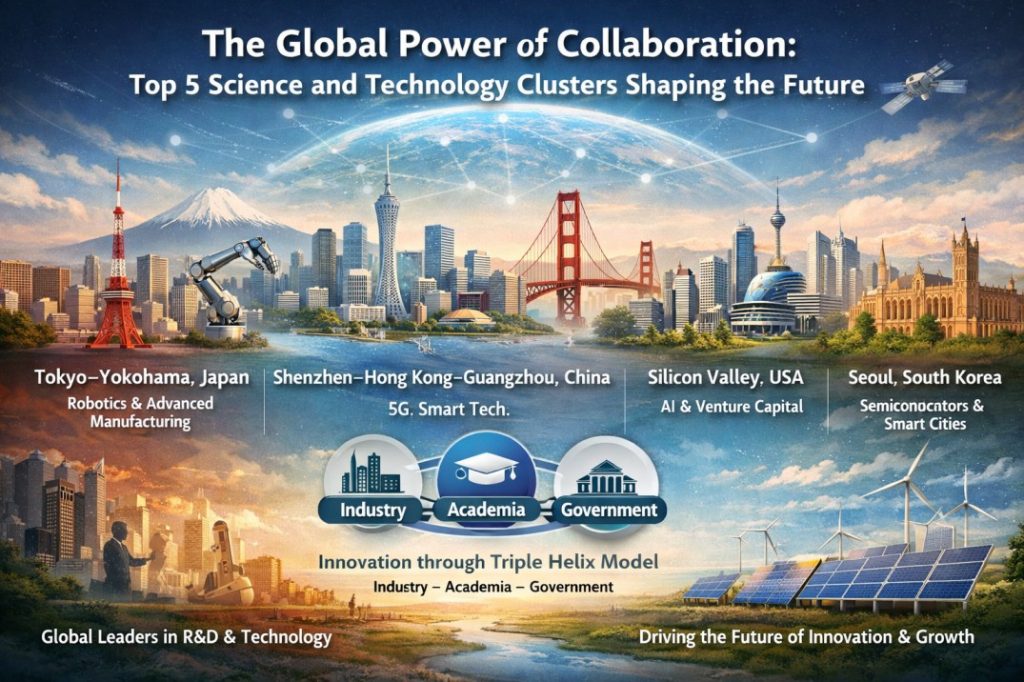
An S&T Cluster is more than a geographical location; it is a translational research engine. Its success is built on the Triple Helix Model—the seamless collaboration between:
- Industry
- Academia
- Government
This synergy reduces the lab-to-market timeline, ensures that research solves real-world administrative and societal challenges, and drives sustainable economic growth.
Top 5 Global Science and Technology Clusters
According to the Global Innovation Index (GII), these regions lead the world in S&T intensity and output:
1. Tokyo–Yokohama, Japan
Core Strength:
Robotics, Electronics, and Advanced Manufacturing
The Secret Sauce:
Massive R&D investment from giants like Mitsubishi Electric and Sony, integrated with world-class research at the University of Tokyo.
2. Shenzhen–Hong Kong–Guangzhou, China
Core Strength:
Smart Manufacturing, 5G, and Hardware Prototyping
The Secret Sauce:
A unique “Design-to-Prototype” speed fueled by Huawei and Tencent, supported by massive state-led infrastructure.
3. San Jose–San Francisco (Silicon Valley), USA
Core Strength:
Venture Capital, AI, and Software Disruption
The Secret Sauce:
The legendary integration between Stanford University and the world’s most valued tech titans (Google, Apple, Meta).
4. Seoul, South Korea
Core Strength:
Semiconductors, Smart Cities, and Display Tech
The Secret Sauce:
Intense industry-led R&D from Samsung and LG, prioritized by a government-mandated digital-first strategy.
5. Cambridge Cluster (Silicon Fen), UK
Core Strength:
Life Sciences, Quantum Computing, and Deep-Tech
The Secret Sauce:
Anchored by the University of Cambridge, it is the premier global model for university-led spin-offs and pharmaceutical innovation.
DRIIV: Pioneering the S&T Cluster Model in India
India has officially entered this global league. DRIIV is one of the 8 prestigious S&T Clusters established by the Office of the Principal Scientific Adviser (PSA) to the Government of India.
This elite network includes clusters in:
- Bengaluru
- Bhubaneswar
- Hyderabad
- Jodhpur
- Pune
- Visakhapatnam
- Northern Region
While global clusters have evolved over decades, DRIIV is fast-tracking India’s R&D ecosystem through mission-oriented innovation:
- Ensuring Water Security
- Green Energy Transition & Environmental Sustainability
- Emerging Technologies for Public
Frequently Asked Questions (FAQs)
What is the role of the Office of the PSA in these clusters?
The Office of the PSA conceptualized these clusters to create formal umbrella structures for S&T organizations to collaborate more effectively on national priorities.
How many S&T clusters are there in India?
There are currently 8 clusters established by the Office of the PSA, including DRIIV (Delhi), BeST (Bengaluru), and RICH (Hyderabad).
Why is “Government Collaboration” emphasized alongside Industry and Academia?
Government participation ensures that technology pilots are tested in real-world public infrastructure and that successful innovations inform future policy.
How does DRIIV support the Atmanirbhar Bharat mission?
By promoting indigenous technology development through the triple-helix model.
Can startups join the DRIIV cluster?
Yes. DRIIV provides startups with access to national testbeds, academic expertise, and industry partners to scale their lab-to-market journey.