
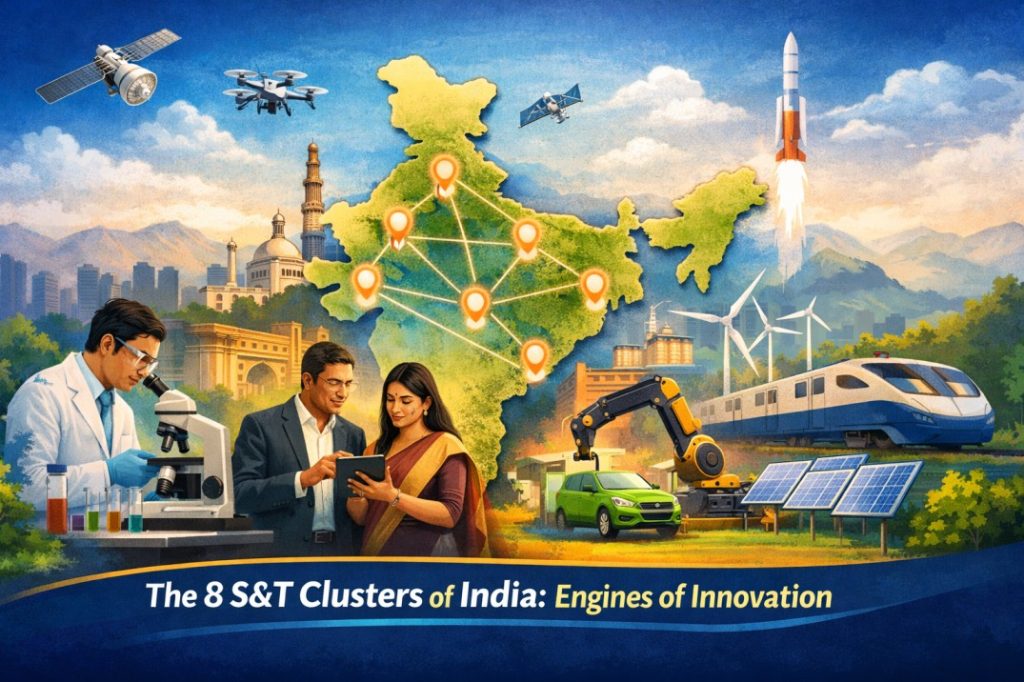
India’s innovation strategy is increasingly anchored by 8 Science & Technology (S&T) Clusters, established by the Office of the Principal Scientific Adviser (PSA) to the Government of India. These clusters were conceptualized under the recommendation of the Prime Minister’s Science, Technology, and Innovation Advisory Council (PM-STIAC) to break institutional silos and address regional challenges through a consortium-based model.
By bringing together Industry, Academia, and Government, these clusters act as regional “engines of innovation”, contributing to the national vision of Atmanirbhar Bharat and Viksit Bharat 2047.
The 8 Strategic Clusters
Each S&T Cluster operates with a specific thematic focus, anchored in regions with high density of R&D institutions and industrial hubs. These clusters aim to address local and national needs, fostering innovation ecosystems that can scale nationally and globally.
Among these, DRIIV (Delhi NCR S&T Cluster) has been particularly impactful. Since its inception five years ago, DRIIV has created a vibrant innovation ecosystem, exemplifying the S&T cluster model’s ability to deliver on national mandates.
The clusters were designed with the vision to propel India towards Atmanirbhar Bharat, by:
- Creating a shared ecosystem across industry, academia, and government
- Becoming regional solution providers for local challenges
- Achieving national and global competitiveness in key technology domains
DRIIV’s journey demonstrates the transformative power of synergistic efforts, showing how collaborative networks can profoundly impact diverse sectors and communities.
Recent Developments
The 8 clusters recently convened at the International S&T Clusters Conference (December 2025), under the aegis of the Office of PSA. Key agreements were formalized to:
- Foster inter-cluster collaborations
- Promote international partnerships
- Evolve these clusters into National Technology Accelerators
Frequently Asked Questions (FAQs)
1. What is the main objective of the S&T Clusters?
To minimize the “lab-to-market” gap by fostering collaboration between industry, academia, and government, solving regional and national challenges.
2. How are these clusters funded?
They are seeded by the Office of PSA, and subsequently sustained through industry partnerships, CSR funds, and government grants.
3. Which is the newest cluster in the network?
The AMTZ Cluster (Andhra Pradesh MedTech Zone) in Vizag, established in 2024, focuses on MedTech innovation and brings together academia, industry, startups, and R&D to address regional and national needs.
4. Can a startup from one city work with a cluster in another city?
Yes. The clusters encourage inter-cluster collaboration, allowing a startup in Pune, for example, to leverage testbeds or expertise in the Delhi (DRIIV) cluster.
5. How do these clusters support “Atmanirbhar Bharat”?
By developing indigenous technologies in critical sectors such as semiconductors, medical devices, and green energy, reducing India’s reliance on imports.

This blog provides a very clear and insightful overview of India’s 8 S&T Clusters as a national innovation map. The way regional strengths, institutional ecosystems, and innovation potential are connected makes it especially valuable for policymakers, researchers, and startups alike. It highlights how coordinated science, technology, and regional planning can drive inclusive and sustainable innovation across India. A very informative and well-structured read.
The blog effectively highlights how India’s S&T clusters can act as anchors for regional innovation and inclusive growth. A thoughtful contribution to discussions on science, technology, and development.