
India’s journey toward AtmaNirbhar Bharat and Viksit Bharat 2047 is being shaped by the adoption of Crucial Technologies that enable sustainable growth, environmental resilience, and digital transformation. Platforms such as DRIIV (Delhi Research Implementation and Innovation) play a vital role in accelerating these technologies through technology validation, pilot deployment, and co-creation.
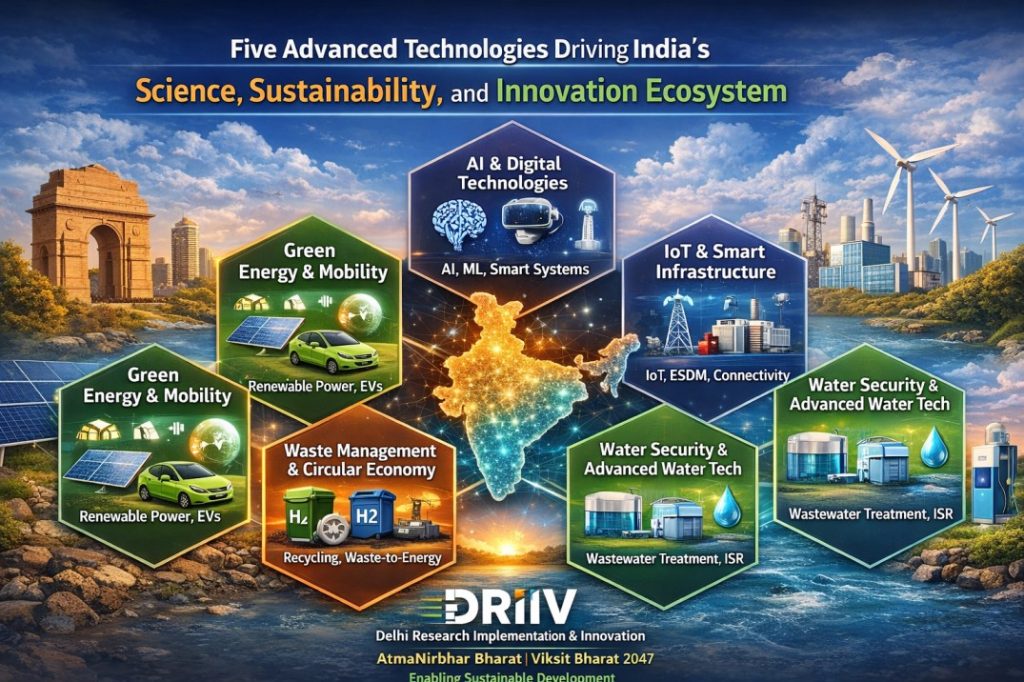
This blog highlights five advanced technology domains central to India’s innovation ecosystem, aligned with DRIIV’s focus areas across critical technologies, energy & environment, and water security.
1. Artificial Intelligence, Machine Learning & Digital Technologies
AI and ML are foundational technologies enabling intelligent, data-driven decision-making. They support real-time monitoring, predictive analytics, and automation.
Key applications include:
- Low-cost air quality monitoring
- Smart water systems
- Robotics for waste segregation
- Blockchain-enabled secure infrastructure
- AR/VR for training
2. IoT, Smart Infrastructure & Critical Communications
IoT combined with electronics system design & manufacturing (ESDM), semiconductors, and critical communications enables smart infrastructure.
Applications include:
- EV charging infrastructure
- Air pollution sensors
- Industrial effluent monitoring
- Waste tracking
DRIIV supports scalable deployment by providing access to urban and industrial testbeds.
3. Green Energy Transition & Sustainable Mobility
Advanced clean energy technologies are critical for energy security and emission reduction.
DRIIV-aligned innovations include:
- Renewable energy integration
- Green hydrogen
- Graphene-based energy storage
- Energy efficiency technologies
- Waste-to-fuel
- Electric mobility ecosystems
These contribute to cleaner air and resilient energy systems.
4. Solid Waste Management & Circular Economy
Circular economy technologies convert waste into value through:
- Decentralized solid waste management
- Waste-to-energy
- Plasma pyrolysis
- E-waste recycling
- Biochar
- Bio-mining
- Construction & demolition waste utilization
- Sustainable packaging
DRIIV enables municipal pilots and industry collaborations to accelerate adoption.
5. Water Security & Advanced Water Technologies
Water security solutions include:
- Inert solid removal (ISR)
- Advanced filtration
- Decentralized wastewater treatment
- Groundwater recharge
- Waterbody rejuvenation
Importantly, microalgae-based phycoremediation for wastewater treatment and oil sludge removal offers a chemical-free, low-energy solution for treating industrial effluents and hydrocarbon-contaminated sludge. These technologies are enhanced through IoT-enabled monitoring and data analytics.
By focusing on implementation-ready innovation, DRIIV ensures advanced technologies move beyond research into real-world impact. Strengthening these domains will help India build indigenous capabilities, address climate and resource challenges, and move toward a sustainable, self-reliant, and globally competitive future driven by science and collaboration.
FAQs
What role does DRIIV play in India’s advanced technology ecosystem?
DRIIV accelerates implementation-ready innovation through technology validation, pilot deployment, and multi-stakeholder co-creation.
Which critical and emerging technologies are highlighted in the blog?
The blog covers AI & ML, IoT and smart infrastructure, green energy and mobility, circular economy technologies, and advanced water solutions.
How do AI and IoT contribute to environmental sustainability?
They enable real-time monitoring, predictive analytics, and automation for air quality management, water systems, and waste operations.
What circular economy solutions are supported by DRIIV?
DRIIV supports waste-to-energy, bio-mining, decentralized waste management.
How does microalgae-based phycoremediation support water security?
It provides a chemical-free, low-energy solution for wastewater treatment and oil sludge removal from industrial effluents.