
India in 2025 is witnessing a decisive shift toward implementation-led innovation. At the heart of this transformation are Science and Technology (S&T) Clusters—collaborative platforms where research, policy, and industry converge to solve critical societal challenges.
What is an S&T Cluster?
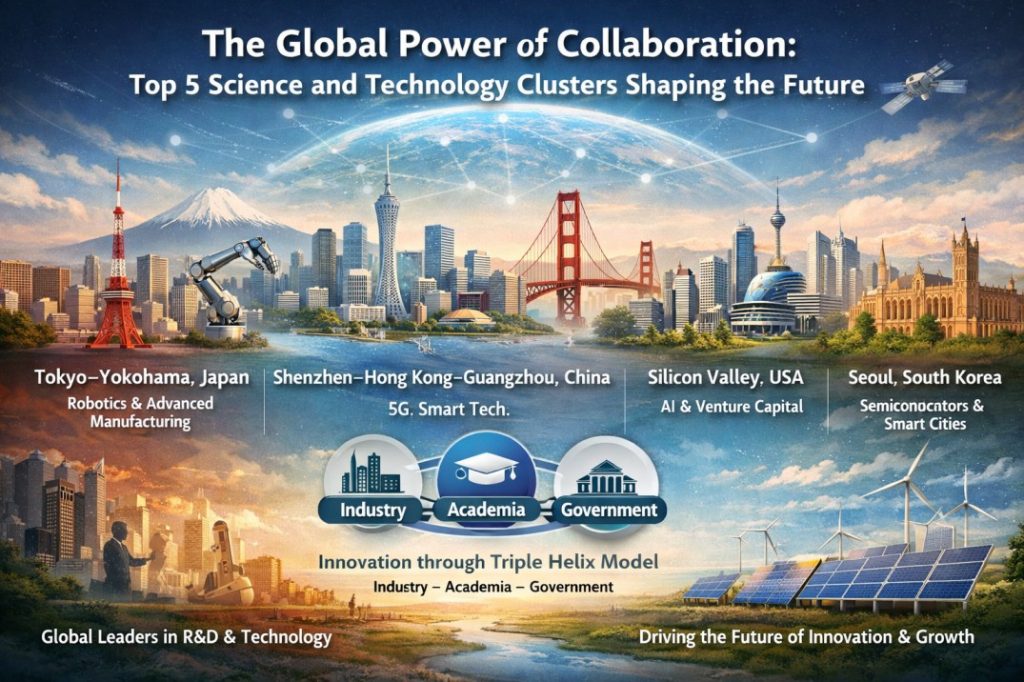
An S&T Cluster is a regionally anchored ecosystem that brings together research institutions, startups, MSMEs, and government stakeholders. Unlike isolated R&D models, these clusters operate on a Triple-Helix platform, facilitating:
- Industry-Academia-Government Collaboration
- Lab-to-Market Translation of deep-tech research
- Pilot Deployments in real-world environments
These clusters are designed to accelerate innovation and create solutions that have direct societal impact.
The Strategic Importance of Clusters
In 2025, S&T clusters are the primary engines for Atmanirbhar Bharat and Science for Sustainability. By developing indigenous technologies in sectors like green hydrogen, semiconductors, and digital health, these clusters:
- Reduce import dependency
- Ensure that economic growth aligns with environmental stewardship
- Build resilient, self-reliant innovation ecosystems
DRIIV: Leading the Delhi-NCR Ecosystem
DRIIV (Delhi Research Implementation and Innovation Venture) is a flagship initiative established by the Office of the Principal Scientific Adviser (PSA) to the Government of India. As one of the 8 S&T Clusters, DRIIV connects premier institutions such as IIT Delhi, IIIT Delhi, and AIIMS with corporate partners and urban local bodies.
Key 2025 Initiatives & Impact:
- Environmental Resilience
Deploying AI-driven analytics and Project SAMEER for real-time air pollution mitigation. - Water Security
Implementing decentralized wastewater treatment and nature-based rejuvenation solutions for waterbodies across Delhi NCR. - Green Mobility
Advancing EV infrastructure and solarized transport corridors in collaboration with DTC and state governments. - Circular Economy
Partnering with global leaders like BASF to scale chemical recycling (pyrolysis) and “Zero-Dump” waste models.
Building a Resilient Future
By the end of this decade, the success of S&T clusters will be visible in cleaner air, smarter cities, and a skilled workforce. Through DRIIV, science is being converted into service, ensuring a future that is innovative, inclusive, and sustainably self-reliant.
Frequently Asked Questions (FAQs)
Q: How many S&T clusters exist in India?
A: There are currently 8 clusters established by the Office of the PSA, including DRIIV (Delhi), BeST (Bengaluru), and RICH (Hyderabad).
Q: How do these clusters support startups?
A: They provide access to specialized labs, national testbeds for technology validation, and direct linkages to industry and government pilots.
Q: What is “Science for Sustainability”?
A: It is the integration of climate-resilient and resource-efficient thinking into every technological innovation, from energy to waste.
Q: Who can participate in the DRIIV ecosystem?
A: Academic researchers, deep-tech startups, MSMEs, and corporate partners looking to co-create and deploy impactful technologies.
Q: What is a “Triple-Helix” platform?
A: It is a collaborative model where Academia (knowledge), Industry (capital/scaling), and Government (policy/infrastructure) work in a synchronized loop.

विज्ञान एवं प्रौद्योगिकी क्लस्टरों पर इस स्तर की विस्तृत जानकारी बहुत कम पढ़ने को मिलती है।