
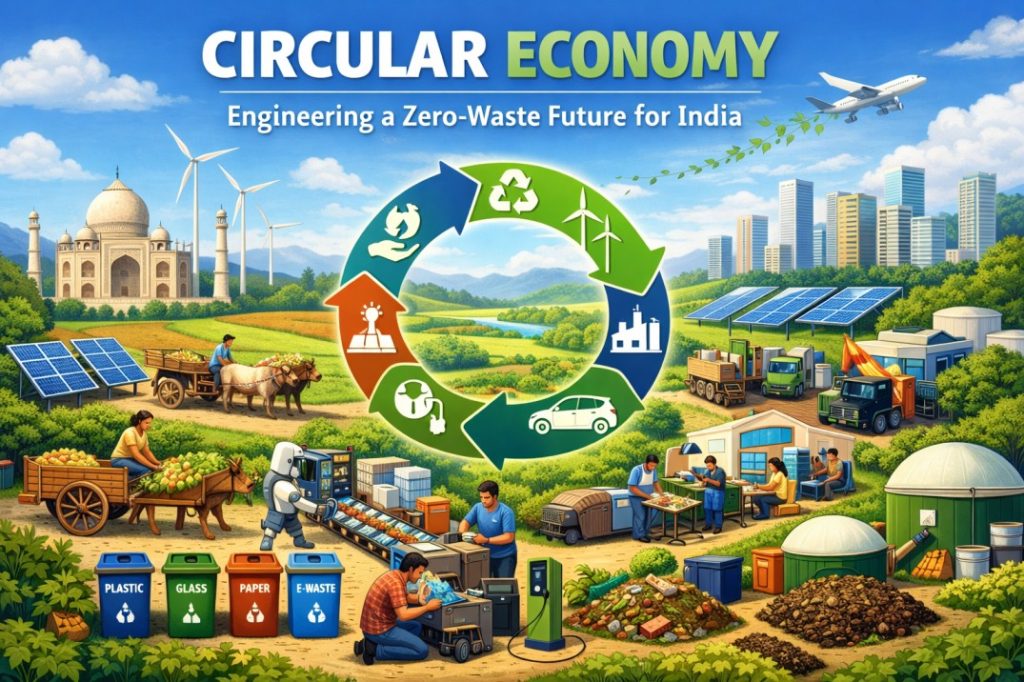
India is at a pivotal economic juncture where industrial growth must decouple from resource depletion. Transitioning to a Circular Economy is no longer just an environmental choice but a strategic imperative to achieve Net-Zero 2070.
With the Government of India identifying 11 focus sectors—ranging from Li-ion batteries to Scrapped Metal and Plastic Waste—the roadmap is clear: shift from “End-of-Life” disposal to “Cradle-to-Cradle” recovery.
The Indian Landscape: Policy & Innovation
India’s circular transition is anchored by a maturing regulatory framework.
- National Circular Economy Framework (NCEF) 2024
- Mission LiFE (Lifestyle for Environment)
Both emphasize mindful consumption and resource efficiency.
Extended Producer Responsibility (EPR)
India has notified market-based EPR regulations for:
- Plastic
- E-waste
- Batteries
- Used oil
These regulations mandate that producers manage the entire lifecycle of their products.
Economic Value
- ₹14 lakh crore ($170 billion+) in additional economic value by 2030
- 1.4 crore jobs creation potential
DRIIV’s Role: Bridging Lab-to-Market
As a premier science and technology cluster, DRIIV acts as the translational engine for circular technologies, converting academic research into scalable industrial pilots.
1. Advanced Chemical Recycling (Plastic Pyrolysis)
Mechanical recycling often degrades plastic quality. DRIIV’s MoU with BASF addresses this by scaling Plastic Pyrolysis.
- Breaks down hard-to-recycle plastics
- Produces high-quality pyrolysis oil
- Oil serves as a secondary raw material for the chemical industry
This approach effectively “molecularly” closes the loop.
2. Community-Led Behavioral Change (CRD)
Technological shifts require societal participation.
The Collective Responsibility Drive (CRD)—a partnership with Blue Planet Environmental Solutions—utilizes behavioral nudging to engage 10 million youth.
The Cycle
- Segregated plastic waste collection
- Upcycling into school benches
- Deployment in government schools
This demonstrates a tangible “waste-to-wealth” outcome.
3. Battery Circularity & Critical Minerals
To secure India’s green energy supply chain, DRIIV focuses on Battery Urban Mining.
Through collaborations with partners like BATX Energies, DRIIV facilitates:
- Recovery of Lithium
- Cobalt
- Nickel
from end-of-life EV batteries, directly supporting the AtmaNirbhar Bharat mission.
Oil Sludge Management & Byproduct Circularity
Please add oil sludge management and show circularity in the byproduct
Integrated Waste Management
DRIIV ecosystem partner’s decentralized models process 7,500 MT of waste annually, integrating:
- Bio-methanation of organic waste into Bio CNG
- Plastic to fuel
- Conversion of inert waste into construction materials (paving blocks)
This ensures that “waste” is merely a misplaced resource.
Frequently Asked Questions (FAQs)
How does the NCEF 2024 impact Indian businesses?
It provides a material-specific roadmap and measurable targets to reduce virgin material use and enhance industry competitiveness.
What is the significance of the DRIIV–BASF partnership?
It focuses on scaling advanced chemical recycling (pyrolysis) to handle plastics that traditional mechanical recycling cannot process.
What is “Battery Urban Mining”?
It is the process of recovering critical minerals like Lithium and Cobalt from spent batteries to reuse them in new battery production.
How does DRIIV’s CRD initiative work?
It encourages students to segregate plastic waste, which is then upcycled into durable furniture for schools, closing the circular loop at a community level.
Why is the “de-licensing” of recycling activities important?
It lowers entry barriers for startups and MSMEs, fostering a more competitive and innovative recycling ecosystem in India.