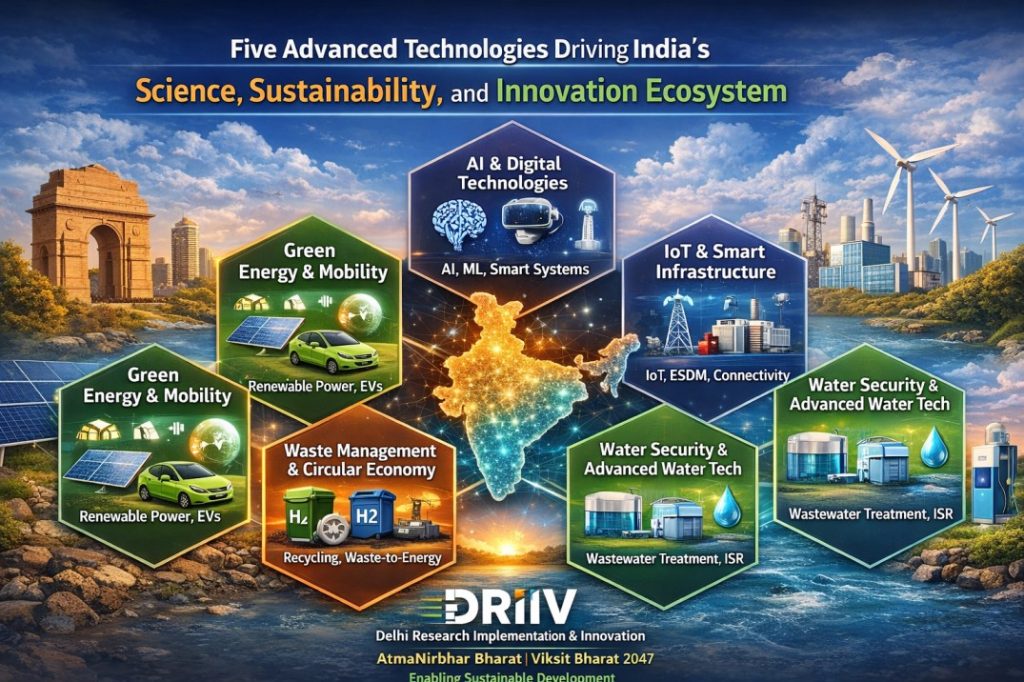

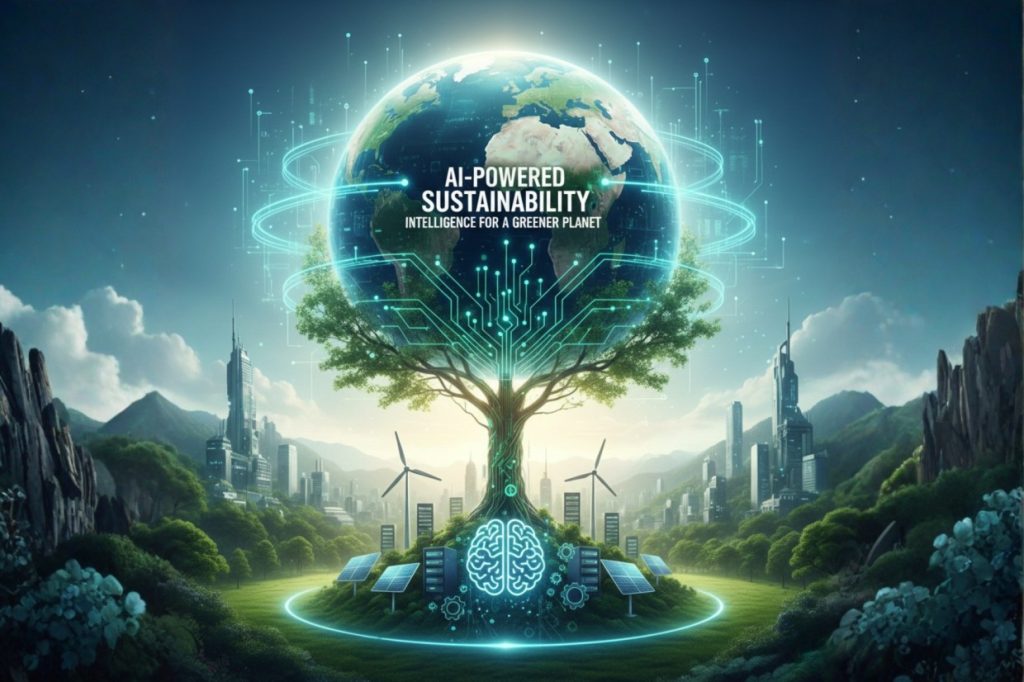
In the race against climate change, Artificial Intelligence (AI) is no longer just a productivity tool—it is a critical enabler of environmental resilience. By processing vast datasets at unprecedented speeds, AI-driven Green Intelligence allows us to predict environmental risks and optimize resource consumption with pinpoint accuracy.
For India, integrating AI into sustainability is a cornerstone of the IndiaAI Mission and the long-term vision of Viksit Bharat 2047.
The Indian Landscape: Policy & Strategic Focus
India’s approach to AI is defined by the principle of “AI for All”, focusing on inclusive and sustainable development. The government has positioned AI as a key driver for the Green Energy Transition through several landmark policies:
IndiaAI Mission (2024)
With an outlay of ₹10,372 crore, this mission provides the compute infrastructure necessary to power climate models and sustainable AI startups.
National Strategy for AI
Spearheaded by NITI Aayog, it prioritizes “AI for Greater Good”, targeting agriculture, healthcare, and smart cities to reduce resource intensity.
Digital Agriculture Mission
Utilizing AI for Precision Farming, this initiative helps farmers optimize water and fertilizer use, reducing the agricultural sector’s carbon footprint.
DRIIV’s Impact: Translating Intelligence into Action
DRIIV (Delhi Research Implementation and Innovation) acts as the vital link between high-level policy and on-ground environmental impact. By connecting AI researchers with urban local bodies, DRIIV is enabling smarter, cleaner cities.
1. Hyperlocal Air Quality Management (Project SAMEER)
Funded by Google, Project Airview+ moves beyond general weather reports to localized action. Using high-precision Aurassure sensors, the project maps pollution at the street level and feeds this intelligence into the My Gurugram App.
This allows residents and the GMDA to identify and tackle specific pollution sources in real time.
2. Targeted Mitigation with Mistify AI
While monitoring is crucial, DRIIV also deploys AI for active suppression. Mistify AI uses Machine Learning and laser sensors to detect dust-heavy activities at construction sites.
Once detected, it automatically triggers atomized misting, suppressing dust using 80% less water than manual spraying.
3. Geospatial Intelligence with Matrix Geo Solutions
DRIIV integrates Matrix Geo Solutions to leverage AI-powered drone and satellite data. This geospatial intelligence enables:
- Asset Monitoring
Tracking large-scale infrastructure projects and mining sites with high precision. - Environmental Surveillance
Mapping green cover and water bodies to monitor ecological health and encroachment in real time.
4. Pandemic Preparedness: Strainflow Suite
Developed in collaboration with IIIT-Delhi, Strainflow is a one-of-a-kind epidemiological early warning system. By analyzing the latent space of genomic sequences—specifically the spike protein of SARS-CoV-2—this AI/ML model provides:
- Early Warning Signals
Predicts new caseloads and the emergence of Variants of Concern (VoC) up to two months in advance. - Healthcare Readiness
Successfully captured surges ahead of the Delta and Omicron waves, allowing administrators sufficient time to manage community health and prepare resources. - Universal Adaptability
While initiated for COVID-19, the model can be adapted to track any infectious disease, making it a powerful tool for long-term pandemic preparedness.
5. AI-Driven Circular Economy (ECOWRAP)
A sustainable future requires a Zero-Dump model. DRIIV partner ECOWRAP utilizes AI-powered waste segregation tracking to address the behavioral challenge of source segregation.
Their platform uses AI/ML algorithms to:
- Rate Segregation
Quantify and reward accurate waste segregation at the source. - Optimize Logistics
Predict waste generation trends and optimize collection routes, ensuring post-consumer waste is reintroduced into the supply chain as a valuable resource.
Frequently Asked Questions (FAQs)
What is the “AI for All” philosophy?
It is India’s policy goal to ensure AI technology is used for inclusive social development, particularly in healthcare, agriculture, and sustainability.
How does hyperlocal monitoring help city authorities?
It identifies pollution hotspots by providing granular-level data using AI, enabling targeted interventions such as cleaning crews or misting trucks where needed most.
What is Mistify AI?
It is a sustainable technology solution that uses artificial intelligence and machine learning to suppress harmful dust pollution at construction and industrial sites, improving air quality and environmental health.
How does the Strainflow model predict surges so early?
It uses a data-driven, de-novo approach that tracks changes in genomic sequences, capturing the diversity of emerging strains before they manifest as large-scale caseloads.
How does AI improve the Circular Economy?
AI tracks material flows, predicts waste volumes, and ensures recyclables remain uncontaminated, making recycling processes financially and operationally viable.