
India’s innovation ecosystem is at a critical inflection point. To address national priorities effectively, the translation of strong research capabilities into deployable solutions must accelerate. The Research Development and Innovation Funding (RDIF) mechanism under the Anusandhan National Research Foundation (ANRF) provides a timely and strategic opportunity to enable this shift.
From the perspective of DRIIV, the Delhi Science & Technology (S&T) Cluster, RDIF is a powerful instrument to enable problem-driven, mission-oriented innovation by aligning research, startups, industry, and government around real-world implementation.
S&T Clusters: The ‘Missing Link’ in RDIF Execution
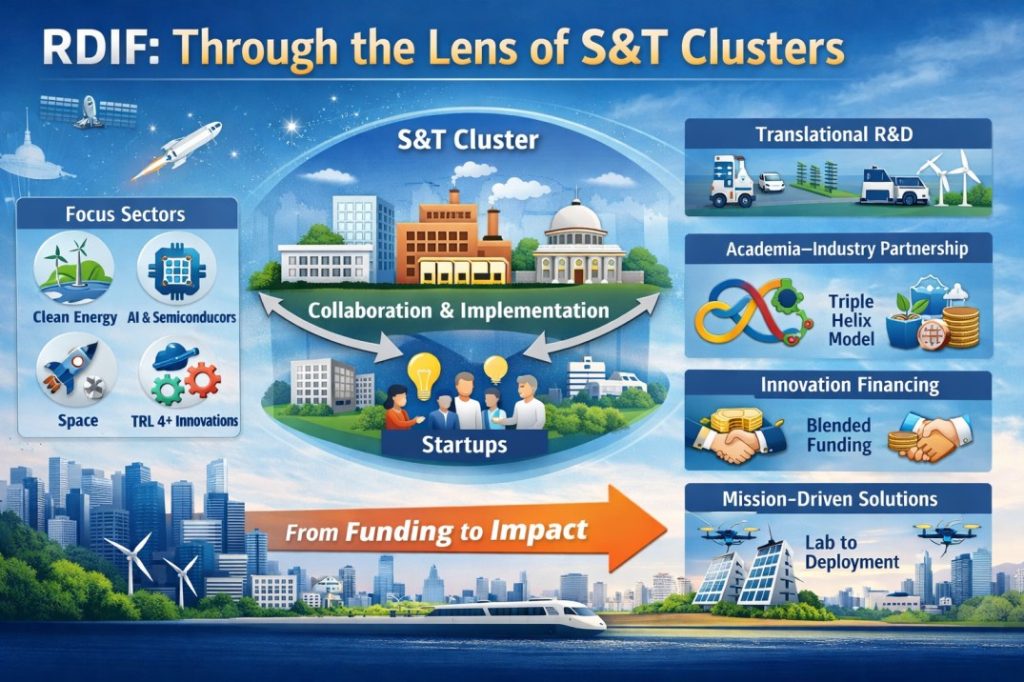
According to Hon’ble Union Minister Dr Jitendra Singh, RDIF represents a new pathway for private R&D. With a focus on sectors such as clean energy, AI, semiconductors, and space, India is poised to create impactful, globally competitive innovations.
While RDIF strengthens funding at critical mid-to-late Technology Readiness Levels (TRLs), its ultimate success depends on effective orchestration on the ground. This is where S&T clusters play a pivotal role.
Platforms like DRIIV act as neutral conveners and implementation partners, translating national missions into actionable innovation pipelines. By identifying high-impact use cases, aggregating demand from public and private stakeholders, and curating multi-partner consortia, clusters ensure that RDIF-supported projects are both technically robust and deployment-ready.
Enabling Translational R&D and Technology Validation
A key strength of DRIIV lies in its ability to provide real-world testbeds and pilot opportunities where RDIF-funded technologies can move directly toward implementation and validation.
For researchers and startups, access to urban infrastructure, utilities, industrial partners, and public sector agencies is often more valuable than funding alone. RDIF and S&T clusters together can support TRL 3–7 transitions, enabling:
- Proof-of-concept development
- Prototype validation
- First-of-a-kind demonstrations
These steps significantly de-risk technologies for scale-up and commercialization.
Strengthening Academia–Industry–Startup Collaboration
RDIF creates a strong incentive structure for collaborative innovation, and S&T clusters are uniquely positioned to operationalize this intent.
DRIIV facilitates partnerships between academic institutions, startups, industry players, and government bodies, ensuring that research aligns with market needs and regulatory realities. This model transforms academia from knowledge generators into providers of deployable solutions, while industry benefits from early access to validated, indigenous technologies.
Building a Sustainable Innovation Financing Ecosystem
Blended financing models can also be explored through cluster platforms. By combining RDIF support with:
- CSR funding
- Industry co-investment
- State innovation schemes
- Multilateral programs
DRIIV can play a critical role in crowding in private capital. This approach reduces technical and deployment risks, strengthens India’s overall innovation financing architecture, and improves capital efficiency across the ecosystem.
The Way Forward: From Funding to Impact
Viewed through the S&T cluster lens, RDIF is far more than a funding program—it is an enabler of systemic transformation.
DRIIV envisions a future where RDIF-funded innovations move seamlessly from laboratories to pilots and then to large-scale deployment through coordinated ecosystem action. This will materialize only if S&T clusters are empowered as long-term implementation partners, not merely facilitators.
Strong governance frameworks, transparent evaluation mechanisms, and continuous engagement between policymakers, funders, and on-ground implementers are imperative to achieve this vision.
Frequently Asked Questions (FAQs)
What is the primary objective of the RDIF under ANRF?
RDIF aims to catalyze private-sector-led R&D and scale up indigenous technologies in sunrise sectors such as AI, semiconductors, and clean energy.
What Technology Readiness Levels (TRL) does RDIF focus on?
RDIF specifically targets mid-to-late stage innovation, providing support for projects at TRL 4 and above.
How do S&T Clusters like DRIIV help in RDIF execution?
Clusters act as implementation partners by providing real-world testbeds, aggregating demand, and curating multi-partner consortia for deployment.
What kind of financing does the RDIF provide to entities?
RDIF provides long-term, low-interest loans for corporates and equity-based risk capital specifically for deep-tech startups.
Why is Industry–Academia–Government collaboration vital for RDIF?
This “Triple Helix” ensures that scientific research is commercially viable, policy-aligned, and addresses real market or societal needs.